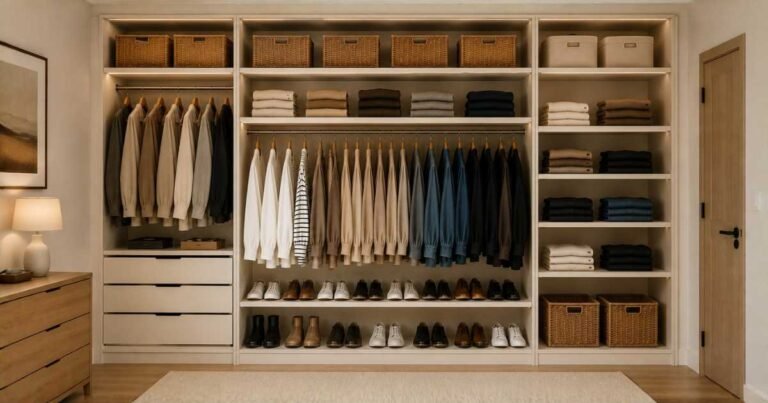
How to Organize a Small Closet With Too Many Clothes
This post may contain affiliate links: full affiliate disclosure

You open your closet looking for one shirt, and somehow three sweaters fall out first. Then a pair of jeans gets stuck behind a jacket. You pull everything forward, make an even bigger mess, and still can’t find what you wanted.
Sound familiar?
Having a small closet isn’t always the real problem. Sometimes it’s simply too many clothes competing for the same little bit of space.
And then you stop.
You look at the closet and wonder how you’re supposed to fit everything in there without making it worse. The good news is, you don’t need a huge walk-in closet to get things under control. A few simple changes can make a surprisingly big difference.
If you’ve been wondering how to organize a small closet, start with the space you already have. Don’t buy a bunch of organizers right away. First, figure out what is taking up room, what you actually wear, and where your closet is being wasted.
Here are some practical small closet organization ideas that can help you create more room without making the closet feel packed all over again.
1. Empty the Closet Before Making Changes

If you’re wondering how to organize a small closet with too many clothes, start by taking everything out. Yes, everything. Put the clothes on your bed or another clean surface so you can actually see how much you own. Once the closet is empty, separate your clothes into things you wear regularly, things you rarely wear, items that need repair, and pieces you’re ready to let go of. Don’t worry about creating perfect piles. You’re simply trying to see what deserves valuable closet space. Most people don’t notice how many forgotten or duplicate pieces they have until everything is sitting in front of them. And once you see it, deciding what stays becomes a lot easier.
2. Keep Your Most-Worn Clothes Within Easy Reach

Your closet should work around your everyday life, not the other way around. Keep the shirts, pants, jackets, and other pieces you wear most often at eye level and toward the front. Clothes that only come out for special occasions can go on a higher shelf or toward the back. This small change can make the closet feel less crowded because you’re no longer moving five things just to reach one shirt. It also makes getting dressed faster. If you notice that certain clothes are constantly ending up on a chair or the floor, pay attention to that. There’s probably a reason. Their current storage spot may simply be inconvenient.
3. Replace Bulky Hangers With Slim Ones

Thick plastic or wooden hangers can take up more room than you realize. Slim velvet hangers are a simple way to create extra hanging space without changing the closet itself. Their narrow design lets clothes sit closer together, which is especially helpful when you’re trying to fit lots of clothes in a small closet. Keep the hangers facing the same direction and avoid cramming them so tightly that you can’t slide one garment out. You don’t need to replace every hanger at once, either. Start with your main clothing section and see how much room you gain. Sometimes a few inches of extra rod space are all you need.
4. Group Similar Clothes Together

There’s no need to make your closet look like a clothing store, but grouping similar pieces together makes a big difference. Keep shirts with shirts, jeans with other pants, dresses in one section, and jackets together. You can arrange each group by color if that helps you find things faster. More importantly, you’ll quickly notice when one category is taking over the closet. Maybe you have enough black tops to fill an entire section. Maybe your jeans are using half the shelf. Seeing everything together makes those patterns obvious. This is one of those simple closet organization tricks that looks almost too easy, but it works.
5. Add a Second Hanging Level

If you have plenty of empty space underneath your hanging clothes, you may be wasting valuable vertical room. A double hanging rod can create another level for shorter pieces such as shirts, skirts, or folded-hangable pants. The upper rod can hold one category while the lower section handles another. This is particularly useful in closets with a tall ceiling but limited width. Before adding one, check that you have enough room for clothes to hang without touching the floor or shelf below. When set up properly, it can nearly double the usable hanging area without making the closet physically larger.
6. Fold Bulky Pieces Instead of Hanging Them

Heavy sweaters and thick sweatshirts can make a hanging section feel packed very quickly. If you have shelf space available, fold these pieces instead. Stack sweaters together, keep sweatshirts in their own section, and place heavier items toward the bottom of the stack. You can also use a fabric storage cube to keep a small category contained. This gives lighter clothing more room on the rod and makes your closet easier to browse. Don’t make huge stacks, though. If you have to pull out the bottom sweater to reach something, the system will probably fall apart within a week.
7. Use Shelf Dividers to Keep Stacks Upright

Folded clothes have a habit of slowly spreading sideways until one shelf becomes a giant pile. Shelf dividers can prevent that. Place them between categories such as jeans, sweaters, shirts, or workout clothes so each stack has its own boundary. Wire dividers work well for open shelving, while clear acrylic versions can give a cleaner look. You don’t need one between every two shirts. The goal is simply to stop piles from leaning into one another. This is a small improvement, but it makes small closet storage ideas for clothes much easier to maintain because everything has a clear place.
8. Turn the Closet Door Into Storage

The back of the closet door is often completely unused. An over-the-door organizer can give you extra pockets or compartments for scarves, belts, hats, small bags, accessories, and other lightweight items. It’s especially helpful if your closet doesn’t have drawers. Keep the things you use regularly in the easiest-to-reach pockets and avoid filling every space just because it’s there. Otherwise, the door becomes another clutter zone. A little restraint matters here. You’re adding useful storage, not creating another place to hide random stuff.
9. Store Shoes Vertically

Shoes can take over the closet floor surprisingly fast, especially when every pair is left side by side. A narrow shoe rack or stackable shoe organizer can use vertical space instead of spreading everything across the floor. Keep everyday shoes toward the bottom or front and move occasional-use pairs higher up. If you have shoes you rarely wear, consider storing them somewhere else entirely. The point is to keep the closet floor usable. When you can actually see the floor again, the entire closet tends to feel more organized.
10. Move Seasonal Clothes Out of the Main Closet

There’s no reason bulky winter sweaters should take up prime closet space during summer, or lightweight linen clothes should fill your shelves during winter. Rotate clothing as the seasons change and store what you’re not currently wearing in labeled storage bins. Under-bed containers, fabric boxes, or stackable plastic bins can work well depending on the space you have. Keep the labels simple, such as “Winter Sweaters” or “Summer Clothes,” so you know exactly what’s inside. Seasonal rotation is one of the easiest ways to make more room in a small closet while keeping clothes you genuinely love.
11. Use the Top Shelf for Rarely Used Items

That high shelf you can barely reach? Save it for things you don’t need every morning. Special-occasion outfits, travel accessories, extra blankets, seasonal items, or sentimental clothing can all live there. Put them inside labeled bins or boxes so loose items don’t turn into a messy pile. Keep everyday clothes lower down where you can grab them without climbing onto a chair. It sounds obvious, but many people do the opposite because they simply fill whatever space is available. A good closet uses the easiest spaces for the things you use most.
12. Give Accessories Their Own Small Space

Scarves, belts, hats, ties, and small accessories can make a closet look messy even when your clothes are organized. Give them one specific place instead of spreading them across shelves and drawers. A small hanging organizer, hooks, or divided drawer tray can keep everything contained. If you have only a few accessories, don’t overcomplicate this. One small basket may be enough. The important part is being able to see what you own. When accessories disappear into a deep box, you’re more likely to forget about them and buy or keep more than you need.
13. Try a Hanging Organizer for Bags

Handbags and small backpacks don’t always need a shelf. A hanging closet organizer can use vertical space and keep several bags together without taking over the floor. Choose a sturdy version if you have heavier bags, and keep your everyday bag somewhere you can grab it easily. Less-used bags can go higher or farther back. If you have only two or three bags, you probably don’t need a large organizer. This is where things go wrong sometimes—people add storage products before figuring out what they actually need to store.
14. Use Cascading Hangers for Pants and Skirts

If your closet rod is crowded with pants and skirts, cascading hangers can help you use vertical space. Instead of every pair taking up a separate section of the rod, several pieces can hang one underneath another. They’re also handy when you like keeping outfits together. Just don’t overload them. If five pairs of jeans are hanging from one spot and you have to wrestle with the hanger every morning, it isn’t really saving time. Use them for a few heavier pieces and leave enough room to remove each item easily.
15. Use the Floor-to-Ceiling Space

If your closet has a lot of unused space above the hanging clothes or shelves, don’t let that vertical area go to waste. A few stackable storage cubes or a narrow vertical organizer can turn that forgotten space into useful storage without making the closet wider. Keep lighter items such as handbags, folded T-shirts, scarves, or small accessories in the higher sections, while heavier items stay lower where they’re easier to reach. Just make sure anything stored up high is stable and not packed so tightly that you have to pull everything down to get one item. In a small closet, going upward is often much smarter than trying to squeeze more things side by side.
16. Make One Shelf Your Everyday Clothing Zone

Sometimes the easiest way to improve clothes organization is to create one dedicated area for things you wear constantly. A shelf or storage cube can hold pajamas, workout clothes, everyday basics, or whatever category makes sense for you. Keep that space limited so it doesn’t slowly overflow. You could use simple fabric bins to separate categories without adding bulky furniture. The benefit is convenience. Instead of searching through several shelves, you already know where those everyday pieces belong. And when something is easy to put away, you’re much more likely to actually put it away.
17. Keep Some Empty Space on Purpose

A closet doesn’t have to be packed from wall to wall to be efficient. In fact, leaving a little empty room between hanging clothes makes everything easier to see and move. Try not to fill shelves until items are spilling over the edge. That breathing room gives you somewhere to place clothes temporarily while getting dressed or sorting laundry. It also prevents the closet from immediately becoming messy again. One of the smartest ways to organize clothes in a small closet is simply to stop treating every empty inch as storage space.
18. Create Limits for Each Clothing Category

Give your clothing categories physical boundaries. Maybe jeans get one shelf, sweaters get one section, and everyday tops get one part of the hanging rod. Once that area is full, you know it’s time to reassess before adding more. This doesn’t mean you can never buy another shirt or keep an extra sweater. It just prevents the closet from quietly expanding until there’s no room left. A system with limits is much easier to maintain than one that depends on constantly rearranging things. You’ll notice the difference after a few weeks.
19. Make Your Closet Match Your Routine

The best small closet ideas are the ones that fit how you actually live. If you change clothes near the closet, keep everyday pieces nearby. If you wear work clothes during the week and casual clothes on weekends, you might find it easier to separate those groups. If you always grab the same three jackets, don’t bury them behind formalwear just because it looks more organized. Your system doesn’t have to follow someone else’s closet rules. Hard to explain, but it works: when storage follows your habits, staying organized requires much less effort.
20. Give the Closet a Five-Minute Reset

You don’t need to reorganize your entire closet every weekend. A quick five-minute reset is usually enough to keep things from sliding back into chaos. Put stray clothes on their hangers, refold anything that has collapsed, return shoes to their rack, and move accessories back to their proper spots. While doing this, notice anything that keeps ending up somewhere else. That may be a sign that its storage location isn’t working. Change the system instead of constantly fighting it. A good closet should make your routine easier, not give you another chore to manage.
FAQs
1. How do you organize a small closet with too many clothes?
Start by emptying the closet and sorting clothes into categories based on what you wear, rarely use, need to repair, or no longer need. Then maximize the available space with slim hangers, vertical storage, shelf dividers, and seasonal clothing storage. Keeping frequently worn clothes within easy reach also makes a small closet easier to maintain.
2. How do you fit lots of clothes in a small closet?
Use the closet’s vertical space instead of trying to fit everything side by side. Double hanging rods, slim hangers, cascading hangers, shelf dividers, and stackable storage can help create more usable space. Folding bulky sweaters and moving seasonal clothes out of the main closet can also free up valuable room.
3. How do you keep a small closet organized
Give each clothing category a specific space and avoid filling every available inch. Keep everyday clothes easy to reach, return items to their designated places, and give the closet a quick five-minute reset when things start getting messy. Leaving some empty space also makes the closet easier to use and maintain.
Final Thoughts
Figuring out how to organize a small closet with too many clothes isn’t really about squeezing more and more things into the same space.
It’s about making the space work better.
Start with the clothes you actually wear. Get rid of what you’ve completely outgrown or no longer use, then use vertical space where it makes sense. Slim hangers, shelf dividers, bins, hanging organizers, and shoe racks can help, but only when they solve an actual problem.
And don’t try to fix everything in one afternoon.
Pick a couple of changes that seem useful for your closet and start there. Once you can see what’s working, the rest becomes much easier.
A small closet doesn’t need to hold everything perfectly.
It just needs to hold the right things in a way that makes your everyday life easier.