
22 Small Space Organization Ideas That Make Every Inch Count
This post may contain affiliate links: full affiliate disclosure

Living in a small home can feel a little strange sometimes.
You don’t necessarily have too much stuff. There just never seems to be quite enough room for all the things you actually use.
A few shoes near the entrance. Mail on the counter. Bags on a chair. Extra blankets taking over a shelf. And somehow, one small pile turns into another.
And then you stop.
You look around and wonder where all that clutter came from.
The frustrating part is that small homes often have more usable space than we think. It’s just hiding in places we rarely notice — behind doors, underneath furniture, inside cabinets, along empty walls, and in those awkward gaps between things.
That’s where smart small space organization ideas can help.
You don’t need to completely redesign your home or buy a house full of storage furniture. Sometimes, one overlooked corner or unused surface can solve a problem that has been annoying you for months.
The goal isn’t to make your home look perfectly organized all the time.
It’s to make everyday things easier to put away.
Here are 22 practical ideas that can help you make better use of the space you already have.
1. Stop Letting Flat Surfaces Become Permanent Storage

When space is limited, every flat surface becomes tempting.
The kitchen counter becomes a mail station. A table becomes a place for bags. A chair becomes tomorrow’s clothes hanger. Before long, there’s barely an empty surface left.
This is one of the first things worth fixing.
Instead of adding another container to the clutter, decide what actually belongs on each surface. Give frequently used items a nearby home that isn’t the counter or table.
For example, keep keys on a wall hook near the entrance, mail in one small tray, and bags on dedicated hooks.
The trick is making those homes easier to reach than the surface you’re trying to clear.
Otherwise, the clutter will simply come back.
2. Find the Storage You’re Already Wasting

Before buying anything, walk through your home slowly.
Look above cabinets. Under beds. Behind doors. Beside furniture. Inside deep cabinets. Along empty wall sections.
You’ll probably find several areas that are doing nothing.
This is where many small space storage ideas begin. You don’t always need more furniture. You may simply need to use the unused space differently.
A narrow gap might fit a rolling cart. A blank wall might hold hooks. The space beneath a bed could store seasonal items.
Most people don’t notice these areas because they’ve always been empty.
But empty doesn’t automatically mean useless. Sometimes it’s your best storage opportunity.
3. Slide a Narrow Cart Into an Awkward Gap

That tiny space between the refrigerator and cabinet can be frustrating.
It’s too narrow for normal furniture, but too large to ignore.
A slim rolling cart can turn it into useful storage without making the area feel crowded. Use the shelves for spices, cooking oils, snacks, cleaning supplies, toiletries, or other small items.
The wheels make a big difference because you can pull it forward when you need something and slide it back afterward.
Look for a cart that is narrow enough to leave the surrounding area comfortable to use.
Measure the gap before buying.
A few minutes with a measuring tape can save you from ordering something that’s two inches too wide.
4. Use the Back of Doors for Things You Reach for Often

Doors have two sides, but most people only use one.
The back of a bedroom, bathroom, pantry, or closet door can become valuable storage with an over-the-door organizer or a few suitable hooks.
Use it for shoes, bags, accessories, cleaning supplies, toiletries, scarves, or lightweight household items.
The best things to store there are items you use regularly. If you have to remove half the organizer just to reach one thing, the system won’t stay useful for long.
Keep the setup simple. You’re adding storage, not creating another place to dig through.
5. Turn Dead Wall Space Into Everyday Storage

An empty wall can do much more than make a room look nice.
A few sturdy hooks can hold bags, hats, jackets, towels, headphones, or frequently used accessories. A narrow shelf can hold small baskets, books, or everyday essentials.
This works particularly well when floor space is already limited.
Instead of adding another cabinet, move some of your storage upward.
That’s one of the easiest space-saving organization ideas because walls don’t take away walking space.
Just keep the arrangement intentional. A wall covered from floor to ceiling with storage can make a small home feel visually heavy. A few well-placed pieces are often enough.
6. Add Shelf Risers Before Adding Another Cabinet

Tall shelves often have a strange problem.
There’s plenty of height, but everything sits on the bottom.
That leaves a large empty space above your dishes, toiletries, cans, folded clothes, or other items.
Shelf risers divide that empty height into two usable levels. They’re particularly helpful inside kitchen cabinets and bathroom storage, where small items often get buried behind taller ones.
You can place plates underneath and bowls above. Or keep smaller bottles on one level and taller bottles on another.
It’s a simple change, but it can make a shelf feel twice as useful. And you don’t have to install anything permanent.
7. Give the Space Under Your Bed a Real Purpose

The area underneath a bed is often one of the largest hidden storage spaces in a small home.
But without a plan, it usually becomes a place where random things disappear.
Use low storage boxes, drawers, or containers that are easy to pull out. Store seasonal clothing, spare bedding, shoes, luggage, or other items you don’t need every day.
Try grouping similar things together. One container for winter clothes. Another for extra blankets.
Another for occasional shoes. That makes the storage much easier to manage later.
If the containers are difficult to reach, you probably won’t use them properly. Choose storage that slides out easily.
8. Use a Slim Shoe Organizer Instead of Letting Shoes Spread Everywhere

Shoes take up more floor space than they seem to.
One pair near the door turns into several pairs, and suddenly the entrance feels blocked.
A slim vertical shoe organizer can keep them contained while using much less floor space than a wide shoe rack.
Another option is an over-the-door shoe organizer for lightweight shoes.
Keep the pairs you wear most often within easy reach. Move seasonal or occasional shoes somewhere else.
The goal isn’t to display every pair you own. It’s to keep the everyday walkway clear. That small change can make an entryway feel much bigger.
9. Create a Small Drop Zone Near the Entrance

The entrance is where clutter starts moving through the home.
Keys, bags, sunglasses, mail, shoes, jackets — everything seems to arrive at once.
A small drop zone gives those things somewhere to land.
You could use two or three hooks, a narrow shelf, and a small basket or tray. That’s enough.
The basket can collect items that need to be carried somewhere else. The tray can hold keys and small essentials. Hooks can handle bags and jackets.
Don’t make the drop zone too complicated.
If putting something away takes several steps, people will eventually stop doing it.
Simple wins here.
10. Try a Storage Ottoman Instead of a Regular One

When a piece of furniture can perform two jobs, small homes benefit.
A storage ottoman can provide a place to sit, rest your feet, or hold a tray while also hiding blankets, pillows, books, toys, or other everyday items.
It can be particularly useful in a living area where you don’t have space for a large storage cabinet.
Choose one that fits the scale of your furniture.
A huge ottoman might technically provide more storage, but it can make the whole space feel tighter.
The best option is usually the smallest size that solves your actual problem.
11. Use Drawer Dividers to Stop Small Things From Taking Over

drawer can hold a surprising amount.
It can also become completely useless surprisingly fast.
Small things move around. Cables get tangled. Socks mix together. Kitchen utensils pile on top of each other. Adjustable drawer dividers create simple boundaries.
Use them for underwear, socks, makeup, kitchen tools, office supplies, batteries, or bathroom accessories.
But don’t divide everything just for the sake of organizing it. Start with the items that are hardest to find. You’ll notice the difference every time you open that drawer.
12. Hang Cleaning Tools Instead of Leaning Them Against Walls

Mops, brooms, dusters, and cleaning brushes are awkward because they’re long.
When they’re left standing in a corner, they take up floor space and often fall over.
Wall-mounted holders can keep them upright and together.
A small section inside a utility area, laundry space, pantry, or suitable closet can become a vertical cleaning station.
Add a couple of hooks for dustpans or reusable cleaning cloths.
This is one of those creative storage ideas for small spaces that doesn’t require much room at all.
You’re simply changing the direction of the storage — from the floor to the wall.
13. Make Your Closet Use More Than One Level

If there’s a lot of empty space above your hanging clothes, your closet probably isn’t using its full height.
A second hanging rod can work for shorter clothing. Shelf risers can create extra levels for folded items. Hanging organizers can use vertical space for bags, accessories, sweaters, or shoes. Keep everyday clothing where it’s easiest to reach. Use higher areas for seasonal or occasional items.
This is especially useful for small room organization ideas because you can increase closet capacity without taking space from the bedroom itself. And don’t pack it too tightly. If you can’t see what you own, you’ll probably keep buying more of it.
14. Use a Lazy Susan Inside Deep Cabinets

Deep cabinets can look spacious until you need something at the back.
Then suddenly, you’re moving six bottles just to reach one. A rotating lazy Susan can make those cabinets much easier to use. It works well for sauces, spices, skincare products, cleaning supplies, jars, and other small containers. Instead of reaching toward the back, rotate the tray. Simple.
Choose one that fits comfortably inside the cabinet with enough room to rotate. Measure the cabinet before buying because a tray that fits technically may not rotate properly once it’s loaded.
15. Put Frequently Used Items on the Inside of Cabinet Doors

Cabinet interiors aren’t the only place you can add storage.
The inside of the door can hold small items without using shelf space.
Try adhesive bins, slim racks, or suitable hooks for measuring spoons, brushes, hair accessories, cleaning cloths, small kitchen tools, or other lightweight items. This can be especially helpful in a bathroom or kitchen where drawers fill quickly. Just check that the added storage doesn’t interfere with shelves or prevent the door from closing.
Small details like this can make a surprisingly big difference in organization ideas for small spaces.
16. Choose a Bedside Shelf Instead of a Wide Nightstand

A full-size nightstand isn’t always necessary. If floor space beside the bed is tight, a narrow wall-mounted shelf can provide enough room for the essentials. Keep your phone, glasses, a book, or a small lamp there. Another option is a bedside caddy that slips between the mattress and bed frame.
The idea is simple: keep the things you actually use close by without sacrificing valuable floor space.And avoid turning the shelf into another clutter zone.
A tiny surface becomes useful because you keep it limited.
17. Use Stackable Bins Inside Cabinets and Closets

When a shelf is deep or tall, stackable bins can create structure.
Use one for extra toiletries and another for cleaning products. In a closet, separate accessories, seasonal items, or bags. Clear containers make it easier to see what’s inside. Matching baskets can look cleaner on open shelves. But there’s one important rule.
Don’t stack containers so high that you can’t comfortably reach the bottom one. Storage that requires a small construction project every time you need something isn’t really helping.
Keep everyday items lower and occasional items higher.
18. Create a Folding Workspace When You Don’t Have Room for a Desk

A permanent desk can be difficult to fit into a small home.
A wall-mounted folding desk gives you a workspace when you need it and frees the floor when you don’t. It can work in a bedroom, hallway, living area, or multipurpose space. Add a narrow shelf above it for notebooks, stationery, or small office supplies.
The important part is keeping the desk surface usable. If it becomes a permanent pile of papers and random objects, the whole point of a folding desk disappears. Give the workspace a simple reset at the end of the day. It takes a minute.
19. Store Chargers and Cables in One Dedicated Place

Cables are small enough to fit almost anywhere.
That’s exactly why they end up everywhere.
One drawer has a charger. Another has an adapter. There’s another cable behind the sofa that nobody remembers owning. Create one charging station for the cables you actually use. A small box, drawer organizer, or basket can keep everything together. Cable clips can prevent frequently used cords from falling behind furniture. You can also separate phone chargers, computer accessories, and less frequently used cables.
You don’t need a complicated system. You just need to stop the cables from migrating around the home.
20. Use Baskets for Things That Don’t Need Perfect Organization

Not every item needs its own little compartment.
Sometimes you just need somewhere to put things.
A basket beside the sofa can hold blankets. One near the entrance can collect everyday items. Another in a bedroom can handle bags or accessories.
Baskets are useful because they make tidying quick. You don’t have to fold everything perfectly. You can simply put it away. That makes them particularly useful for busy homes where an organization system needs to be realistic rather than picture-perfect. Choose baskets that fit the space you already have. Not the other way around.
21. Make the Space Above Cabinets Work for You
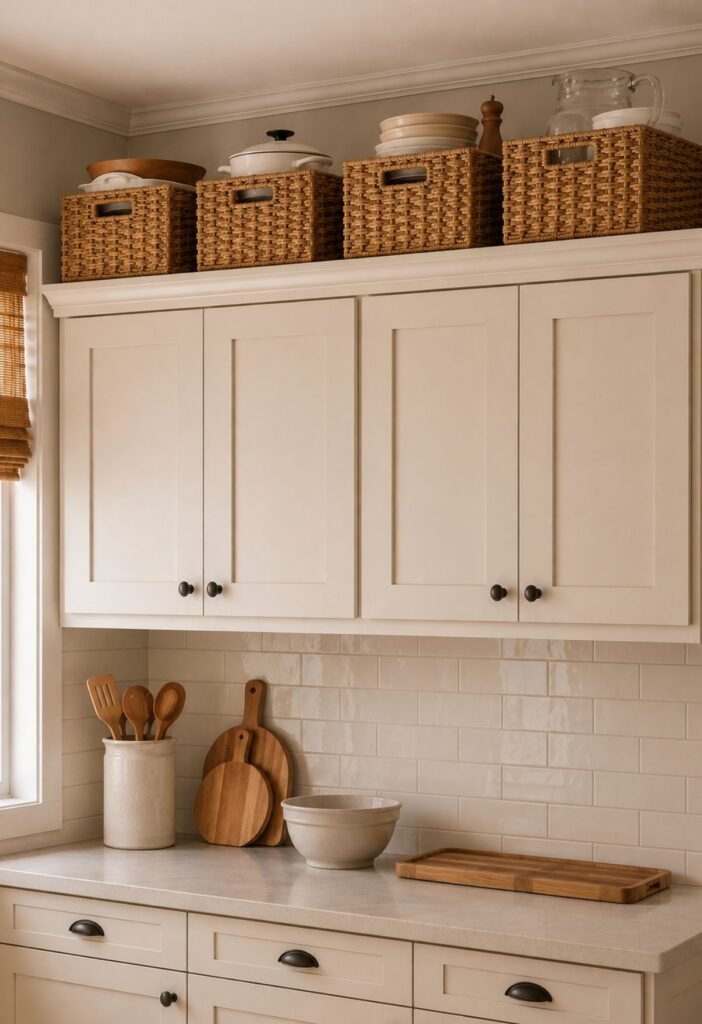
If your kitchen cabinets stop before the ceiling, that empty area can be useful for things you don’t need every day. Use attractive baskets or containers for seasonal kitchenware, serving pieces, extra appliances, or other occasional items.
But don’t use the space as an excuse to keep things you never use. Moving clutter higher doesn’t make it disappear. Before storing something up there, ask yourself when you last used it. If the answer is “I honestly don’t remember,” it may be time to let it go. Storage is valuable.
Don’t spend it on things you don’t need.
22. Give Every Everyday Item a Clear Home

This is the idea that ties everything together.
A small home becomes much easier to manage when frequently used things have an obvious place to return to. Not just somewhere they can fit. Somewhere they belong.
Keys might need a hook near the entrance. Bags might need hooks beside the door. Shoes might need a narrow rack. Blankets might need a basket next to the sofa. The best small home organization ideas work with your natural habits instead of constantly fighting them.
If you always drop your bag in the same place, put a hook there. If mail always lands on the kitchen counter, put a small tray nearby. If shoes always collect beside the door, create storage there. Hard to explain, but it works.
When the storage location matches the habit, putting things away becomes almost automatic.
FAQs
What is the best way to organize a small space?
Start with the areas that create the most daily clutter. Then look for unused vertical and hidden space, such as walls, doors, cabinet interiors, and underneath furniture. Use simple storage that keeps frequently used items easy to reach.
How do you organize a small apartment without making it feel crowded?
Use storage that takes advantage of existing space instead of adding lots of bulky furniture. Wall hooks, narrow shelves, under-bed storage, slim carts, storage ottomans, and over-the-door organizers can provide useful storage while keeping the floor open.
How can I make a small home feel more organized?
Give frequently used items a clear home, reduce unnecessary clutter, and avoid filling every empty area with storage. A small home usually feels better when there is both practical storage and some visual breathing room.
Final Thoughts
Small-space organization isn’t about squeezing something into every available corner.
It’s about using the space you already have more intentionally.
Look up.
Look behind doors.
Check underneath furniture.
Notice the awkward gaps.
And pay attention to the places where clutter naturally collects. Those are usually telling you exactly where storage needs to go. You don’t need to change everything at once. Start with one frustrating problem. Fix it. Live with the solution for a while.
If it makes everyday life easier, keep it.
If it doesn’t, change it.
That’s what makes small space organization actually work in real homes. Not perfection. Just simple systems that make it easier to put things away and find them again. Every inch doesn’t need to be filled. It just needs to be used well.
