
23 Small Home Office Organization Ideas That Actually Work
This post may contain affiliate links: full affiliate disclosure

Working from a small home office sounds simple until you actually have to use one every day.
The desk gets covered with papers. A charger somehow ends up under a notebook. Pens disappear when you need them most, while things you barely use sit right in front of you. And if your office is just a small corner of a bedroom, living room, or hallway, there isn’t much room to move things around.
And then you stop.
You look at the space and realize the problem isn’t necessarily that you have too much stuff. It just doesn’t have a proper place to go.
That’s where a few smart changes can make a surprisingly big difference. These small home office organization ideas aren’t about creating a picture-perfect office or buying a whole new set of furniture. They’re about making the space easier to use, easier to clean, and a little less annoying every day.
Whether you’re working with a tiny desk, a spare corner, or a compact room, these home office organization ideas can help you make better use of the space you already have.
1. Start by Clearing the Space You Actually Use

Before adding storage, look at the area around your desk. Most people don’t notice this, but the things taking up the most space aren’t always the things they use most often.
Remove old papers, empty boxes, duplicate supplies, unused notebooks, and anything that has slowly migrated onto your desk. You don’t need to organize everything in the house. Just focus on the workspace itself.
This is one of the simplest home office decluttering ideas because it immediately shows you what you’re working with. Once the unnecessary stuff is gone, you’ll probably find that your desk isn’t quite as small as it felt before.
And don’t rush to buy organizers yet. You may discover that you already have enough storage. It was just being used badly.
2. Give Every Everyday Item a Nearby Home

A small office becomes messy quickly when frequently used items don’t have an obvious place to go.
Think about the things you reach for almost every day: pens, headphones, chargers, sticky notes, notebooks, scissors, documents, and your water bottle. If you have to search for them, they’ll eventually end up wherever you last put them.
Give each category a simple home close to your desk. Keep pens together, charging cables together, and current paperwork in one easy-to-reach spot.
It sounds almost too basic, but it works. When putting something away takes only a few seconds, you’re much more likely to actually do it.
3. Use a Monitor Stand to Create a Second Storage Level

Your monitor is already taking up valuable desk space, so why not make that space underneath it useful?
A monitor stand with a shelf or small drawers can create a second level on the desktop. You can slide a keyboard underneath, keep a notebook below the monitor, or store small office supplies in the space underneath.
This is especially useful for small desk organization ideas because you’re adding storage vertically instead of making the desk wider.
A simple stand can also make the desk look less crowded. Everything has a little more breathing room, even though you haven’t technically added more surface area.
4. Put a Small Drawer Unit Beside the Desk

If your desk has no drawers, don’t assume you need a new desk.
A narrow rolling drawer unit can fit beside or underneath many desks and give you a convenient place for the small things that create visual clutter. Pens, notebooks, cables, stamps, spare batteries, and personal items can all disappear into drawers.
The trick is choosing a unit that is actually narrow enough for your space. Measure first. Seriously.
For small office storage ideas, a slim drawer unit is one of those boring-looking solutions that becomes incredibly useful once you start using it.
5. Move Paperwork Off the Desktop

Paper has a strange way of multiplying.
One document becomes three, then a small stack, and before long you have papers sitting under your laptop and beside your coffee mug. If you work from home, this can make a small office feel messy even when everything else is organized.
Create a simple paper system with two or three categories, such as “To Do,” “Keep,” and “Recycle.” A vertical file holder can keep these categories upright and within reach without covering the whole desk.
You don’t need a complicated filing system. If it takes too much effort to maintain, it probably won’t last.
6. Take Advantage of the Wall Behind Your Desk

When floor space is limited, look up.
The wall above and around your desk is often completely unused, even though it can hold quite a bit. A pegboard, floating shelf, narrow rail, or wall-mounted organizer can move supplies off the desktop and into easy reach.
This is where home office ideas for small spaces become more interesting. Instead of trying to squeeze another cabinet into the room, you’re using an area that was already there. Keep the things you use regularly at eye level or within arm’s reach. Less frequently used items can go higher up.
7. Keep Cables From Taking Over the Desk
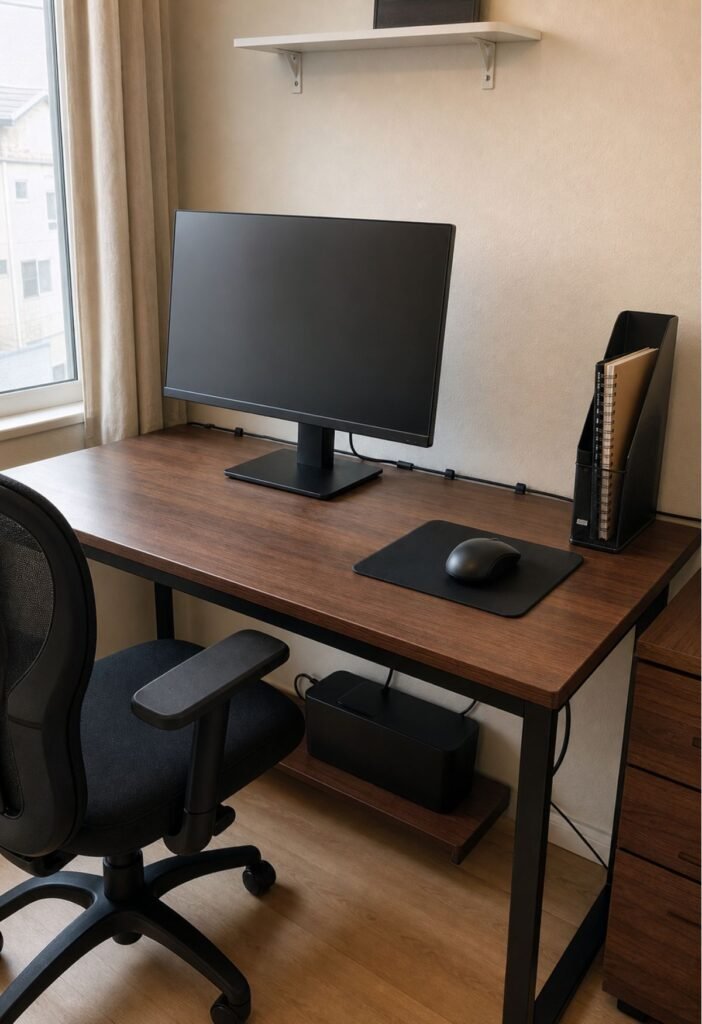
A messy cable situation can make an organized office look messy in about five minutes.
Laptop chargers, monitor cables, phone cords, headphones, and extension cords tend to collect around the back and sides of a small desk. Worse, they get tangled together and become annoying whenever you need to unplug something.
Use adhesive cable clips, a cable box, or simple Velcro cable ties to keep everything grouped and routed toward the back of the desk.
You don’t need every wire to be perfectly hidden. The goal is simply to stop cables from becoming a pile. Once they’re separated and secured, you’ll notice the difference almost immediately.
8. Use a Narrow Rolling Cart for Supplies

A rolling cart can be surprisingly useful when you don’t have room for a traditional office cabinet.
Choose a slim version and use each level for a different category. One shelf could hold notebooks and paper, another could store technology accessories, and the bottom could hold larger supplies.
The best part is that you can move it when you need more floor space. If your home office shares a room with another activity, that flexibility matters. It’s a simple space saving home office idea that doesn’t require permanent installation.
9. Create a Small Charging Station

If your phone, earbuds, tablet, smartwatch, and laptop all need charging, your desk can quickly turn into a cable nest.
Instead of charging everything wherever there happens to be an open outlet, create one dedicated charging area. A small tray or charging station can hold the devices while cables stay routed behind or underneath the desk.
This works particularly well if you spend a lot of time at your desk because you aren’t constantly moving chargers around. Hard to explain, but it makes the whole workspace feel calmer.
10. Make Use of the Space Under the Desk

The area underneath your desk is often wasted.
Depending on the desk design, you can use it for a slim rolling drawer, a small filing box, a footrest with storage, or a compact basket for items you don’t need constantly.
Just don’t fill every inch. Your legs need room too. For small home office storage ideas, under-desk storage is useful because it keeps supplies close without putting more objects in your line of sight. That’s a big win in a small room.
11. Add a Floating Shelf Instead of Another Cabinet

Sometimes you don’t need another piece of furniture. You need one shelf.
A floating shelf above the desk can hold books, small storage boxes, a few office supplies, or decorative items. Because it doesn’t use floor space, it can work well in a narrow office or a desk tucked into a bedroom corner.
Use baskets or matching containers for smaller items so the shelf doesn’t become another clutter zone.
And leave some empty space. A shelf packed from end to end won’t make the room feel organized, even if everything technically has a place.
12. Use a Desk Organizer for the Small Stuff

Tiny office supplies are easy to underestimate.
Paper clips, sticky notes, USB drives, pens, pencils, scissors, and other little items don’t take up much space individually. Together, though, they can cover half a desk.
A compact desktop organizer keeps those items contained and makes them easier to grab. Choose one based on what you actually use rather than buying the biggest organizer you can find.
If you only need three compartments, three compartments are enough. More storage isn’t always better.
13. Turn a Closet or Cabinet Into Hidden Office Storage

If your small office is inside a bedroom or another shared room, hidden storage can be a lifesaver.
A nearby closet shelf or cabinet can hold extra printer paper, backup supplies, files, cables, shipping materials, and other things you don’t need every day. Keep the desktop limited to current work and everyday essentials.
This is one of the more practical home office storage solutions because the room can look tidy without requiring you to constantly rearrange everything.
When you finish working, close the door and the office disappears a little. That’s useful if your workspace is part of your living area.
14. Keep Your Printer Somewhere Other Than the Desk

Printers are bulky. On a small desk, they can take over almost the entire surface.
If possible, place the printer on a nearby shelf, rolling cart, filing cabinet, or dedicated stand. Keep paper and printer supplies underneath it so everything related to printing stays together.
You don’t need to have the printer within arm’s reach. A few extra steps are usually worth gaining a large section of usable desk space. This is one of those small office organization ideas that feels minor until you get the space back.
15. Use Vertical File Storage Instead of Horizontal Stacks

Horizontal stacks look harmless at first.
But once you put one notebook on top of a few papers, then another document on top of that, the bottom items become almost impossible to access. You end up moving the entire pile just to find one sheet.
Vertical storage changes that. A magazine holder or upright file organizer lets you see categories from the side and pull out one item without disturbing everything else. Label a few sections if you need to, but don’t overcomplicate it.
For home office desk organization ideas, this is especially helpful when paperwork is part of your daily routine.
16. Give Your Desk a “Nothing Else” Zone

One part of the desk should stay almost completely clear.
Maybe it’s the center where you write. Maybe it’s the area beside your keyboard. The exact spot doesn’t matter as much as the rule: nothing permanent lives there. This gives you somewhere to work when you need to spread out documents or take notes.
In a tiny office, having one clear working zone can make the entire desk feel bigger than it actually is. And when clutter starts creeping in, you’ll notice it before things get completely out of control.
17. Use Matching Bins for Supplies You Don’t Need Every Day

Not everything needs to be visible.
Extra notebooks, envelopes, craft supplies, backup cables, shipping materials, and seasonal office items can go into labeled bins or boxes. Keep those containers on a high shelf, inside a cabinet, or under the desk. Matching containers aren’t necessary, but they can make open shelving look much calmer.
The important part is the labels. If you can’t remember what’s inside a box, you’ll eventually open every box looking for one thing. That’s not organization. That’s treasure hunting.
18. Make a Small Space for Incoming Mail

Mail is one of those little problems that can quietly create a lot of clutter.
Instead of leaving envelopes on the desk or kitchen counter, give incoming mail one specific spot. A wall pocket, narrow file holder, or small tray can work.
Have a second place for mail that actually needs attention. That way, unopened mail doesn’t mix with documents you’ve already dealt with.
This is a tiny system, but it prevents one of the most common sources of everyday desk clutter.
19. Choose a Desk With Storage Built Into It

If you’re replacing your desk anyway, storage should be part of the decision.
A compact desk with drawers, a shelf, or a small cabinet can give you much more usable storage without increasing the overall footprint. Look for designs that use vertical space or place drawers underneath the work surface.
You don’t need a huge executive desk. In a small room, that can actually make things worse. A simple compact desk with thoughtful storage can be much more practical than a larger desk that gives you plenty of empty surface but nowhere to put anything.
20. Use the Back of the Door

The back of a door is easy to forget.
A hanging organizer can turn it into useful storage for notebooks, office accessories, cables, files, or other lightweight items. This can be especially handy when every wall and shelf is already being used.
Just make sure the organizer doesn’t interfere with the door closing. For small office storage ideas, this is one of the easiest ways to add capacity without taking up valuable floor space.
21. Create a Small Reference Shelf

If you regularly use certain books, notebooks, manuals, or reference materials, give them one dedicated shelf.
Instead of scattering them across the desk, floor, and nearby furniture, keep the most-used ones together. A narrow shelf is usually enough.
You can also keep a small basket there for notebooks or current projects.
This is less about storing a huge amount of stuff and more about reducing the number of places you have to look. When everything you use regularly lives in one general area, the office becomes easier to maintain.
22. Keep Only Your Current Project on the Desk

Sometimes the problem isn’t storage. It’s too many active projects.
If you have several notebooks, folders, papers, and supplies spread across the desk, decide which project you’re actually working on right now. Move the rest into a drawer, basket, or labeled file.
This doesn’t mean you have to throw anything away.
You’re simply separating “working now” from “working later.” That small distinction can make a cramped desk feel much more manageable.
And yeah… that’s where things often go wrong. Everything gets treated like it’s urgent, so everything stays visible.
23. End the Day With a Five-Minute Reset

A small office doesn’t need a complicated cleaning routine. It needs a repeatable one.
At the end of the workday, put away the obvious clutter, return supplies to their homes, straighten the papers, route any loose cables back where they belong, and clear your main working area.
Five minutes is usually enough when you do it regularly.
If you skip it for a week, though, those five minutes can turn into a much bigger job. Most people don’t notice how much easier organization becomes when the reset happens before the mess has time to grow.
FAQs
How do I organize a small home office with very little space?
Start by protecting your actual working surface. Remove items you rarely use, then move storage upward with shelves, pegboards, wall organizers, or cabinets. Under-desk storage and narrow rolling carts can also add capacity without making the room feel crowded.
What should I keep on a small home office desk?
Keep only the things you use regularly, such as your computer, a few writing supplies, your current notebook, and anything essential for your daily work. Extra paperwork, backup supplies, cables, and rarely used equipment can go into drawers, bins, shelves, or nearby storage.
What is the best storage solution for a tiny home office?
There isn’t one solution that works for every room. In most cases, a combination of vertical wall storage, a compact drawer unit, under-desk storage, and simple containers works better than one large storage cabinet. The key is using unused space without making your workspace harder to access.
Final Thoughts
A small office can still be comfortable and practical.
You just have to be a little more intentional about where things live. Keep the desk clear enough to work, use the walls and unused corners, and don’t let everyday clutter become permanent.
Start small. One drawer, one shelf, one messy cable pile.
You’ll notice the difference sooner than you think.