
21 Kids Room Organization Ideas That Maximize Small Spaces
This post may contain affiliate links: full affiliate disclosure

A small kids’ room can look completely fine in the morning and somehow feel packed by bedtime.
A few books end up on the floor. Clothes get tossed over a chair. Toys spread from one corner to another, and suddenly there doesn’t seem to be a single empty spot left. The room isn’t necessarily messy. It just isn’t using its space very well.
And then you stop.
Where is everything supposed to go?
That is the tricky part of organizing a small kids’ room. You can’t magically make the room bigger. What you can do is make better use of the space that’s already there. Walls, corners, the space under the bed, the back of a door, even a few inches beside a dresser can become useful.
Most people don’t notice this at first. They try to fit more storage into the room, when the better answer is often to change how the existing space is being used.
The good news? You don’t need a perfect playroom or a huge built-in closet. A few thoughtful changes can make a small room feel much easier to live in.
Here are some kids room organization ideas that focus on exactly that.
1. Start by Giving Every Activity Its Own Little Zone

One of the easiest ways to make a small kids’ room feel less crowded is to stop treating the entire room like one giant storage area.
Think about what actually happens in the room. Sleeping, getting dressed, reading, playing, drawing, doing homework. These activities don’t necessarily need separate rooms. They just need small, defined areas.
A little reading corner could have a narrow bookshelf and a floor cushion. The dressing area can stay close to the closet or dresser. Toys can have one specific play zone instead of being scattered throughout the room.
This is especially helpful when you’re figuring out how to organize a small kids room because it gives everything a natural place. You don’t need dozens of containers. You just need to know where each type of item belongs.
And yeah, that alone can make the room feel surprisingly different.
2. Use the Walls Before Adding More Furniture

When floor space is limited, look up.
Walls are probably the most underused part of many small kids’ rooms. A narrow wall-mounted bookshelf, a few sturdy hooks, or shallow shelves can hold plenty without taking up the floor area.
This works particularly well for books, small toys, art supplies, and things your child uses regularly. Instead of adding another cabinet, use vertical space that is already available.
You can also place a few shelves above a desk or beside the bed, depending on the room layout. Keep everyday items within easy reach and put less-used things higher up.
The idea isn’t to cover every wall with storage. That can make the room feel busy too. Use a few strategic spots and leave some breathing room.
Sometimes the best storage is the storage you don’t notice.
3. Choose a Bed That Gives You Storage Underneath

The space underneath a bed is too useful to ignore, especially in a small kids’ room.
If the bed has built-in drawers, even better. Otherwise, low-profile storage boxes or rolling containers can turn that empty area into a hidden storage zone.
This is a great place for seasonal clothes, extra bedding, shoes, stuffed animals, or toys that aren’t used every day. Keeping those items under the bed frees up closet and dresser space for things your child reaches for more often.
Look for containers that can slide out easily. If they’re difficult to access, the space may become a forgotten dumping ground.
Clear containers can also help because you can see what’s inside without pulling everything out.
It’s a simple change, but it can give you a surprising amount of extra room without adding another large piece of furniture.
4. Make the Closet Work Harder

A closet doesn’t have to be used only for hanging clothes.
If your child’s closet has a lot of unused vertical space, add a second hanging level for shorter clothes. A hanging organizer can create extra compartments for folded items, accessories, or shoes.
You can also use a small shelf organizer to divide one large shelf into several smaller sections. Kids’ clothes are small, so one wide shelf can often hold more than you expect when it’s divided properly.
One common mistake is filling the closet from the bottom up while leaving the upper half almost empty. Look at the whole height of the closet.
That unused space is valuable.
For younger kids, keep everyday clothing at a reachable height and move less-used items higher. It makes getting dressed easier too.
5. Add a Narrow Bookcase Instead of a Wide One

Books can take up more space than you’d think.
A wide bookcase might seem like the obvious solution, but in a small room, a narrow vertical bookshelf can often work better. It uses height instead of valuable floor width.
Look for a slim design that fits against a wall without making the walking path feel cramped. A narrow shelf beside the bed or near a reading corner can be enough for a child’s regular collection.
If you have more books than the shelf can hold, rotate them. Keep current favorites accessible and store the rest somewhere else.
You don’t need every book visible at the same time.
For small bedroom organization ideas for kids, this kind of vertical thinking can be one of the easiest wins.
6. Turn the Back of the Door Into Useful Storage

The back of a bedroom door is easy to overlook.
A hanging organizer can create several small compartments without taking up any floor space. Depending on the design, it can hold hair accessories, small toys, craft supplies, socks, shoes, or other little items that tend to wander around the room.
This works especially well for things that don’t need a full drawer.
The key is not to overload the door. Too much weight can make it awkward to open and close, and a giant collection of items hanging there can look messy.
Pick one category and give it a home.
For example, craft supplies can all stay behind the door instead of taking over the desk.
Small change. Useful space.
7. Create a Tiny Homework or Drawing Station

If your child needs a desk, you don’t necessarily need a big traditional desk.
A compact wall-mounted desk or narrow writing table can provide enough space for homework, drawing, reading, or crafts. When paired with a chair that can slide underneath, the area stays open when it’s not being used.
Use the wall above it for a few shelves or a small organizer. Keep pencils, notebooks, and frequently used supplies there instead of filling the desktop.
This is one of those kids room ideas where the goal isn’t to add more furniture. It’s to make one piece of furniture do more.
A small work surface can be enough when everything around it has been planned carefully.
8. Use Stackable Bins for Toys That Don’t Need to Stay Out

Not every toy needs to be displayed.
Stackable bins can be useful when you need to store larger groups of toys while keeping the footprint small. Instead of spreading several containers across the floor, stack them vertically in one corner or inside a closet.
Try grouping similar things together. Building toys in one bin. Dolls or figures in another. Craft supplies somewhere else.
You don’t need an elaborate labeling system for a child’s room, either. Simple picture labels can work well for younger kids.
The main goal is easy access.
If your child can’t reach or open the container, the system probably won’t last. Choose storage that matches their age and how they actually use the room.
9. Swap a Bulky Nightstand for a Small Rolling Cart

A traditional nightstand can take up more floor space than it deserves.
If your child needs a place beside the bed for books and small items, try a compact rolling cart instead. Its narrow shape can provide several levels of storage while using very little floor area.
The top can hold bedtime essentials, while the lower shelves can store books or small toys.
And because it can move, you’re not locked into one layout.
If the room needs to be rearranged later, simply move the cart. Hard to explain, but flexible storage often works better in a child’s room because their needs change so quickly.
10. If Your Kid Shares a Room, Zones Matter More

Shared rooms are a different kind of small kids room organization ideas problem. It’s not just about storage — it’s about each kid feeling like they have their own space, even in a genuinely tight footprint. A rug on each side, a curtain divider down the middle, or even just color-coded bins per kid can create that mental separation without a single wall going up.
Sometimes the fix isn’t more furniture, it’s just a clearer line — literally or visually — between “your side” and “my side.” That alone cuts down on a surprising number of arguments over whose stuffed animal is whose, or which drawer someone’s allowed to open.
Bunk beds are the obvious space-saver for shared rooms, but even two twin beds pushed to opposite corners with a shared shelf between them can work in a pinch.
Give each kid at least one small space that’s entirely theirs to decorate however they want. A single shelf is enough. It matters more than the square footage does.
11. A Storage Bench Solves Two Problems at Once

A storage bench placed under the window, or at the foot of the bed, gives you seating and storage in the exact same footprint. That’s the whole appeal for small bedroom organization ideas for kids — you’re not really adding furniture, you’re combining two separate pieces into one that does double duty.
Fill it with off-season clothes, extra bedding, or the toys that only really come out on rainy afternoons. It’s quiet storage, the kind that doesn’t scream “storage bin” the second someone walks in the door, which is nice if you care at all about how the room looks day to day.
A cushioned top also gives you a spot to put shoes on in the morning, which sounds minor until you realize how often that used to happen on the floor.
Look for one with a hinged lid that stays open on its own, so digging through it doesn’t turn into a two-person job every time.
12. Drawer Dividers Fix the Mess You Don’t See

Drawers look fine from the outside even when they’re total chaos on the inside. Drawer dividers keep socks, underwear, and small clothing items from turning into one giant tangled pile every single time the drawer opens. It’s a small fix, honestly kind of a boring one, but it’s one of those creative kids room storage ideas for small rooms that makes the daily routine noticeably smoother.
You’ll notice the difference the first time your kid actually finds matching socks without dumping the whole drawer onto the floor first. Mornings get a little faster. Not dramatically, but enough that you notice it.
Adjustable dividers are worth the slightly higher price, since fixed-size ones rarely match the exact drawer you already own.
13. Use Hooks at Child-Friendly Heights
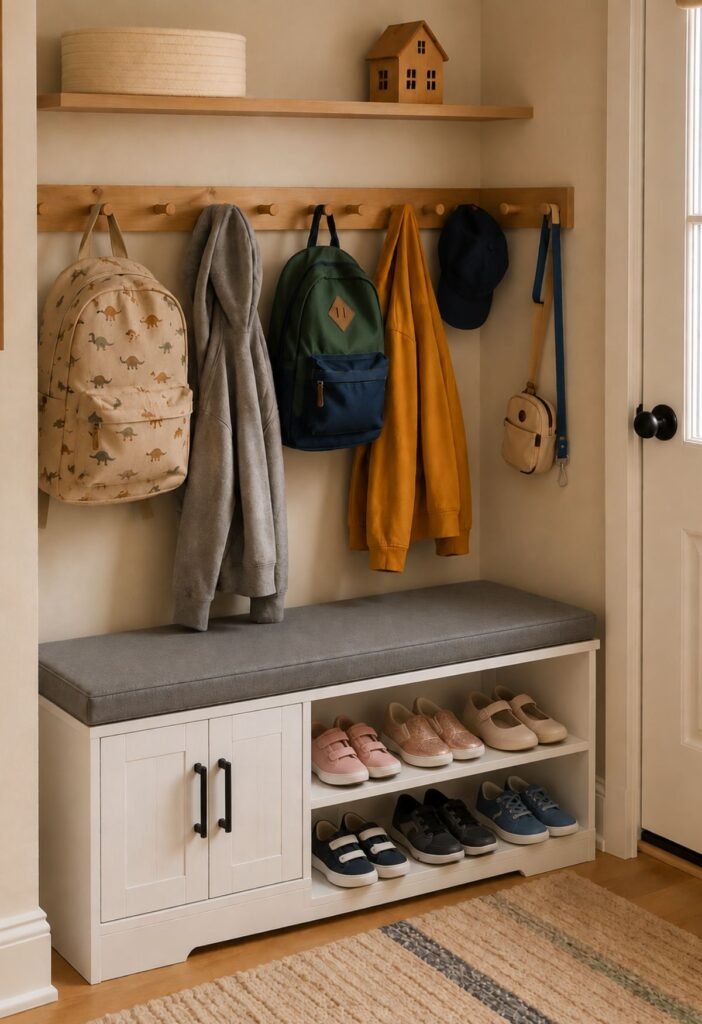
Hooks are one of the simplest kids room storage ideas, but they can make a real difference.
Install a few sturdy hooks where your child can actually reach them. Jackets, backpacks, hats, costumes, and frequently used bags can go there instead of landing on the floor or being thrown over a chair.
You don’t need a whole wall of hooks.
A small row near the door may be enough.
For younger children, keeping hooks low also encourages independence. They can grab what they need and put it away without asking for help every time.
If you have a little extra wall space, this is a much better use of it than leaving it completely empty.
14. Use a Pegboard for Flexible Wall Storage

A pegboard can be surprisingly useful in a small room because the arrangement can change as your child grows.
Hooks, small baskets, and shelves can hold different things without needing to install a completely new storage system every time.
One year it might hold art supplies. Later, it could store school accessories, headphones, small toys, or hobby supplies.
Place it above a desk or on another open wall where the items won’t interfere with furniture.
Just make sure it is securely installed and that heavier items are stored appropriately.
This is one of those smart storage ideas for small kids rooms that can stay useful for years rather than months.
15. Use the Space Above the Dresser

Look at the wall above the dresser.
Is it completely empty?
If so, you may have a perfect place for a shallow shelf or a few small wall-mounted organizers. Keep everyday items there, such as hair accessories, books, small baskets, or decorative pieces that don’t need to sit on the dresser itself.
But don’t turn the area into a wall of stuff.
A small kids’ room already has plenty happening visually. Keep the shelf simple and avoid putting too many loose objects there.
The goal is to move some things upward, not to make every inch of the room look occupied.
You’ll notice the difference when the dresser top finally stays clear.
16. Try a Lofted or Raised Bed When the Layout Allows It
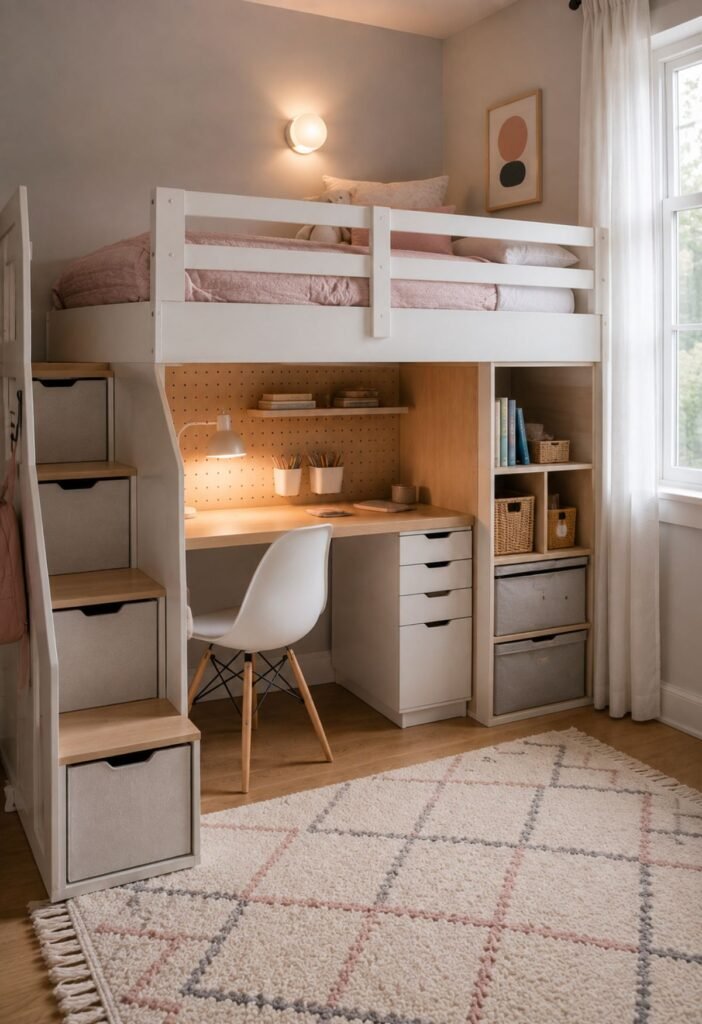
If the room is extremely tight, changing the bed layout can create an entirely new usable area.
A lofted bed can open up space underneath for a desk, reading nook, storage, or play area. This can be particularly useful when floor space is limited but the room has decent ceiling height.
However, this isn’t something to choose just because it looks clever. Safety, age suitability, ceiling height, access, and the bed’s design all matter.
If a lofted setup isn’t appropriate, a standard bed with built-in drawers can provide a safer and simpler alternative.
The bigger idea is to think vertically. Sometimes the best way to create more floor space is to move one major function upward.
17. Keep a Small “Everyday” Basket Near the Entry

Some things are used constantly.
Shoes. Hairbrushes. School bags. Favorite accessories. A hoodie that somehow gets worn every day.
Instead of trying to put these items away in different places every single time, give them one easy drop zone.
A small basket near the door can work well for soft items or everyday accessories. A couple of hooks above it can handle backpacks and jackets.
This isn’t about making the room perfectly tidy.
It’s about catching the things that normally end up on the floor.
A simple drop zone can be especially helpful in busy households because it doesn’t require much effort to maintain.
18. Rotate Toys Instead of Storing Everything at Once

Sometimes the room feels too small because there are simply too many things in active use.
You don’t necessarily need to get rid of everything. Try rotating toys instead.
Keep a manageable selection available and store some of the less-used toys elsewhere. After a while, swap them.
This can make the play area feel fresh without requiring more storage furniture.
It also gives you a chance to notice what your child actually uses. Some toys may sit untouched for months while a few favorites get played with constantly.
When planning kids room organization ideas for small spaces, this is worth remembering: organization isn’t only about where things go. It’s also about how much needs to be available at one time.
19. Choose Furniture That Does More Than One Job

When every square foot matters, multifunctional furniture can be incredibly useful.
A bed with drawers can replace a separate storage cabinet. A desk with built-in shelves can reduce the need for a bookcase. A storage bench can provide seating and a place for toys.
Think about what each piece of furniture is doing.
If one item serves only one purpose but takes up a lot of room, ask whether another option could do two jobs.
This doesn’t mean every piece needs to be multifunctional. That can make a room feel overly complicated.
Just choose the pieces where combining functions actually makes sense.
20. Use Matching Small Baskets Inside Larger Storage

Large drawers and cabinets can become messy very quickly.
Small baskets or bins inside them create simple sections without permanently changing the furniture. You can separate socks, accessories, small toys, school supplies, or other loose items.
This works especially well for deep drawers where little things tend to disappear.
The nice part is that the baskets can be removed and rearranged whenever your child’s needs change.
If you’re looking for creative kids room storage ideas for small rooms, don’t overlook the inside of furniture. Sometimes the problem isn’t a lack of storage. It’s that the available storage is too open and difficult to manage.A few simple dividers can make a big difference.
21. Leave Some Empty Space on Purpose

This might be the most important idea of all.
When organizing a small room, it’s tempting to use every available inch. Add another shelf. Another basket. Another hook. Another box.
But a room needs empty space too.
Leave some open floor area for playing. Keep a little breathing room around furniture. Don’t fill every wall simply because you can.
A well-organized room isn’t one where every object has been squeezed into the smallest possible gap. It’s a room where the important things are easy to find and there’s still enough space to move, play, and relax.
That’s the difference between storing more and actually organizing better.
And honestly, you don’t need to tackle the entire room in one weekend.
Start with the biggest problem. Maybe it’s toys. Maybe clothes are taking over the floor. Maybe the closet is barely being used. Fix that one thing first. Then look again.
You may discover that you don’t need another cabinet after all. You just needed to use the space differently.
FAQs
How do you organize a small kids room with limited space?
Use vertical walls, under-bed storage, the back of doors, and compact furniture to keep items off the floor. Group similar belongings together and leave the center of the room open for playing and moving around.
What are the best storage ideas for a small kids room?
Under-bed drawers, wall-mounted shelves, narrow bookcases, storage bins, hooks, and multifunctional furniture are especially useful. They add storage without taking up too much valuable floor space.
How can I make a small kids room feel bigger?
Keep furniture along the walls, avoid filling every empty corner, and use vertical storage instead of bulky floor units. Keeping some open floor space makes the room feel less crowded and more comfortable.